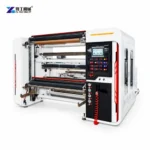
Unwind control must respond as parent-roll diameter falls
A web tension control system keeps a moving film, paper, foil or laminate within a usable force range while the parent roll unwinds, the web passes through the knife section and finished lanes rewind. Buyers often compare only maximum speed or automation level. That misses the real purchasing task: confirming whether the machine can hold stable tension at the material’s normal low and high limits as roll diameter, speed and lane geometry change.
The primary search task is therefore specification, not a generic definition. The buyer must connect material behavior, parent-roll inertia, web width, minimum slit pattern, acceleration, feedback device and rewind method. A suitable system should prevent wrinkles and web breaks before the knives, preserve tracking through the cut and build rolls with consistent hardness. It must also make accepted settings repeatable for operators rather than depending on continuous manual correction.
Material Data That Defines The Required Tension Range
Start with material, thickness or basis weight, elastic behavior, coating, surface sensitivity and width range. A thick paper web may tolerate a higher force but still curl when moisture varies. Thin film can elongate during acceleration. Aluminum foil needs low, stable control and can retain wrinkles caused by a short disturbance. Laminates may have different friction and stiffness on each face. The supplier needs normal production samples, not only a material name.
Add maximum parent-roll width, diameter and mass; core diameter; minimum and maximum finished width; rewind diameter; lane count; required roll hardness and allowed edge defects. Parent-roll inertia determines how strongly the unwind must brake during speed changes. Narrow rewind lanes may require differential torque because identical shaft torque does not guarantee identical roll build across lanes.
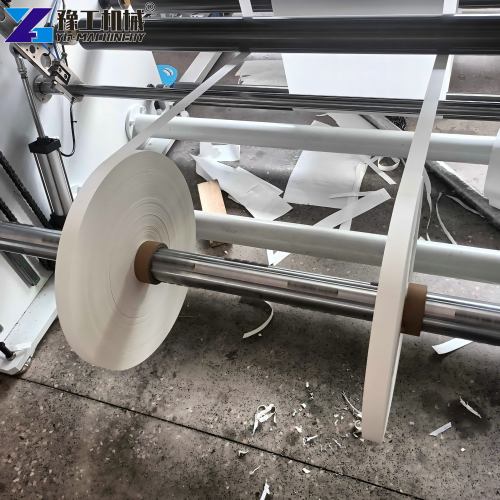
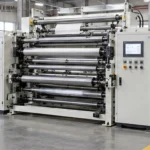
Rollers and guiding establish a stable path before cutting
Slitter Tension Zones And Their Control Functions
A practical slitter usually separates unwind, slitting or draw, and rewind behavior. Each zone has a different disturbance. The unwind sees falling diameter and changing inertia. The draw section establishes web isolation and tracking. The rewind sees increasing diameter and multiple finished lanes. Treating the whole path as one tension value can hide a problem in one section by overcorrecting another.
Unwind And Infeed Control
The unwind brake or motor must release material smoothly while diameter falls. Confirm minimum controllable torque, diameter calculation or sensing, brake cooling, dancer travel and emergency-stop behavior. The system should remain stable at the smallest parent roll and during a splice or acceleration. Oversized brakes without fine low-torque resolution can be as troublesome as undersized components.
Draw And Rewind Control
Driven rollers isolate disturbances before the knife section. At rewind, torque must rise appropriately with roll diameter while taper tension reduces excessive compression in the outer layers. Differential shafts or slip elements can compensate for small lane differences. Ask how the controller handles narrow and wide lanes together and how recipes store the accepted taper, acceleration and torque limits.
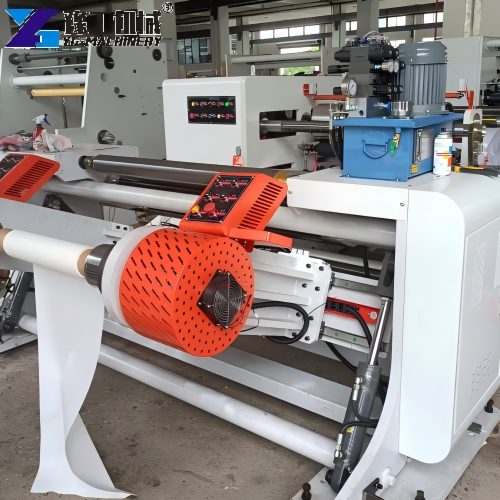
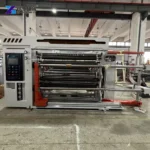
The controller coordinates feedback, brakes and section drives
Feedback Methods For Different Slitting Processes
Load cells measure web force at a sensing roller and support closed-loop correction. A dancer adds mechanical storage and can absorb transient changes while its position provides feedback. Open-loop diameter compensation can be useful where the material and process are stable, but it cannot directly verify actual tension. Many machines combine methods: diameter-based feed-forward control with load-cell or dancer feedback for correction.
Selection should reflect the lowest force that must be measured accurately, not only the sensor’s maximum rating. Review sensor range, roller wrap angle, signal resolution, calibration method, controller update rate and actuator response. The mechanical path matters because poor bearings, roller imbalance, insufficient wrap or web slip can make good electronics report misleading values.
Each rewind lane must build a consistent finished roll
Parameters Required In The Tension Control Proposal
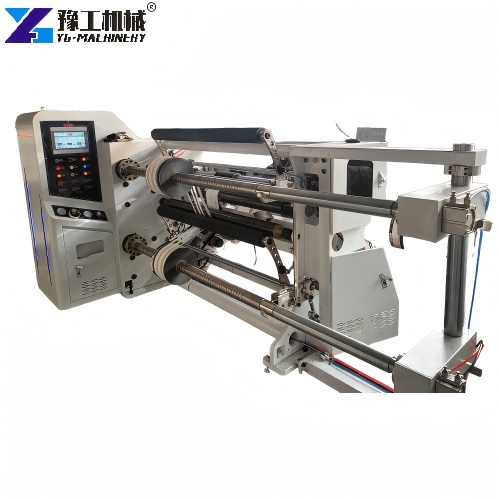
The following YG model envelope is a mechanical reference from the current slitter-rewinder range. It does not by itself guarantee tension accuracy or 450 m/min production on every material. The proposal must add the material-specific tension range, feedback method, unwind and rewind arrangement, acceleration profile and acceptance test.
Parameter
YG-1100A
YG-1300A
YG-1600A
Maximum unwind width
1100 mm
1300 mm
1600 mm
Maximum unwind diameter
φ1400/1600 mm
φ1400/1600 mm
φ1400/1600 mm
Minimum slit width
50 mm
50 mm
50 mm
Maximum rewind diameter
φ1000/1200 mm
φ1000/1200 mm
φ1000/1200 mm
Operating-speed envelope
10–450 m/min
10–450 m/min
10–450 m/min
Total power
22 kW
22 kW
24 kW
Machine weight
5600 kg
6000 kg
6400 kg
Request a separate control schedule showing the number of zones, sensor type and range, unwind actuator, rewind shafts, installed drives, taper-tension function, recipe storage, calibration tools and alarm behavior. State whether shaftless loading, guiding, trim extraction, static control or inspection is included. This prevents a quotation from using “automatic tension” as an undefined feature.
Separate tension zones prevent one correction disturbing another
Tension Performance Testing Before Acceptance
Use the thinnest or most elastic normal material, the widest parent roll and a demanding slit pattern. Record material batch, parent diameter and mass, core, lane widths, speed stages, acceleration, controller settings and rewind configuration. Observe threading, startup, steady production, slowdown and stopping. Many wrinkles, lateral shifts and telescoping defects appear during transitions rather than at constant speed.
Measure tension at defined points if the test plan requires it, but also inspect the product. Check slit width, edge condition, wrinkles, web tracking, roll hardness and telescoping on inner, middle and outer layers. Compare lanes across the shaft. A stable display is not proof when finished rolls build differently. Repeat the accepted run after a setup change to show that recipes and calibration can reproduce the result.
Finished-roll evidence confirms whether the recipe is stable
Tracing Roll Defects To The Tension Control System
Wrinkles entering the knife section may indicate unstable unwind force, misaligned rollers, poor spreading or an abrupt draw difference. Repeated web breaks may come from excessive peaks during acceleration, damaged edges or a sensor and drive response that is too slow. Lateral wandering requires guiding and roller alignment checks before tension is increased.
Telescoping and soft finished rolls direct attention to rewind torque, taper settings, shaft grip, core quality, separator position and lane-to-lane compensation. A hard outer layer can indicate insufficient taper. Different hardness across lanes may reveal shaft slip or web-caliper differences. Troubleshooting should change one variable at a time and retain the material, speed and lane pattern used for comparison.
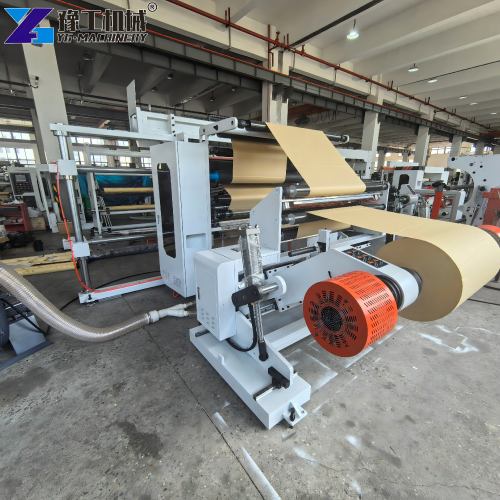
Drive response matters during acceleration and deceleration
Web Tension Control System Ordering Checklist
The final technical scope should name the web range, parent and finished-roll geometry, control zones, feedback devices, actuators, rewind method, guiding, drive power, speed envelope, electrical supply and safety functions. It should identify which values are published machine limits and which performance points were actually demonstrated with the buyer’s material.
Also define commissioning records, operator training, calibration procedure, spare sensors, brake or drive service items and recipe backup. If the factory will run several materials, agree separate starting recipes and changeover checks. A web tension control system becomes valuable when the operator can reproduce accepted rolls after diameter, width and product changes—not when the control panel merely shows a tension number.