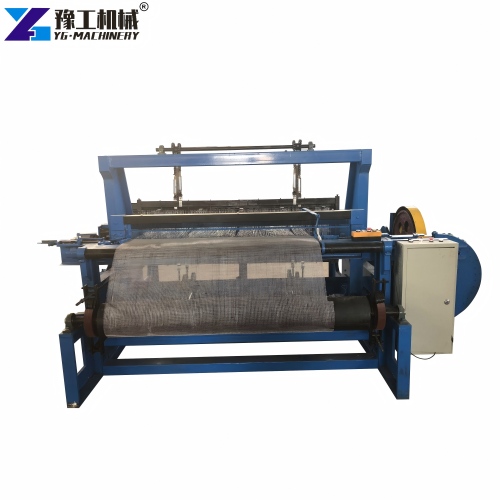

The Chain Link Fence Making Machine market is shifting fast toward automation. Rising labor costs push more factories to upgrade from manual or semi-auto lines. Tighter delivery schedules add extra pressure too. Buyers now compare a Chain Fencing Machine on more than price alone. Output speed, mesh consistency, and payback time all matter just as much. This guide walks through the parameters, the automation decision, and the numbers you need before you invest.

Chain Link Fence Making Machine Parameters
Before comparing automation levels, you need to know what a typical unit can actually produce. The table below lists two common configurations, covering wire diameter, mesh size, and output speed.
| Model | YG-20-100 | YG-25-80 |
| Wire diameter | 1.6-4mm | 2-4mm |
| Mesh size | 20-100mm | 25-100mm |
| Mesh width | 0.5-4m | 0.5-4m |
| Speed | 70-80m²/h | 120-180m²/h |
| Mesh length | 30m, adjustable freely as per your request | |
| Mesh side | Knuckled and twisted, or knuckle, or twisted | |
| Raw material | Galvanized wire, PVC-coated wire, etc. | |
| Machine size | 4.2*2.2*1.7m | 6.7*1.43*1.8m |
| Weight | 2000kg | 4200kg |
| We can design the machine according to your wire diameter, mesh hole size, mesh width, and voltage. | ||
Both models accept galvanized wire or PVC-coated wire, and mesh length adjusts freely to match your project specs. We also design custom units around your wire diameter, mesh hole size, mesh width, and voltage requirements.

Semi-Automatic vs Full-Automatic Chain Link Fence Making Machine
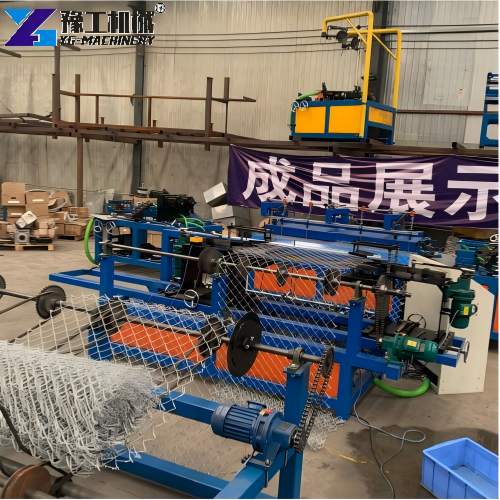
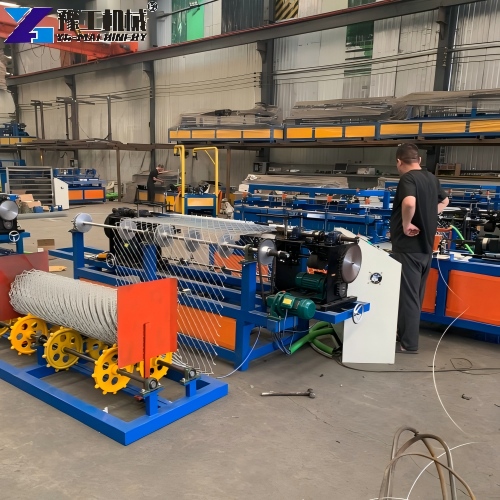
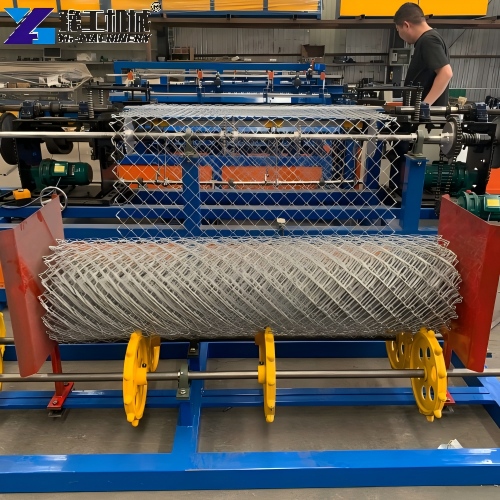
This is the core decision most buyers face. A semi-auto unit needs an operator to manage wire feeding and takes more manual adjustment between mesh sizes. A full-auto Chain Link Manufacturing Machine runs continuously with minimal supervision, and it switches specifications faster once programmed.
Speed tells only part of the story, though. Full-auto units also cut down on inconsistent mesh tension. The machine controls wire feed automatically, so results no longer depend on an operator’s hand pressure.
| Factor | Semi-Automatic | Full-Automatic |
| Labor needed | 1-2 operators per shift | 1 operator can monitor multiple lines |
| Output speed | Lower, depends on operator pace | Higher, consistent regardless of shift |
| Mesh consistency | Varies with operator skill | Stable, controlled by PLC settings |
| Changeover time | Longer manual resets | Faster programmed switching |
| Upfront cost | Lower | Higher |
| Best fit | Small orders, tight budgets | Bulk orders, export contracts |
Neither option is automatically the right choice for every buyer. A workshop filling occasional local orders may not need the full-auto investment yet. A factory shipping containers every month usually recovers that extra cost within a year or two.
How to Calculate ROI on a Fence Making Machine Investment?
Return on investment depends on three numbers. These are your output speed, your labor cost per shift, and your current order volume. Start by comparing what a full-auto Chain Fencing Machine produces per hour against your semi-auto baseline.
Here’s a simple way to estimate payback time:
- Find your monthly output gain (full-auto speed minus semi-auto speed, times working hours).
- Multiply that gain by your average selling price per square meter.
- Subtract your added electricity and maintenance costs.
- Divide the price difference between the two machines by your net monthly gain.
For example, the YG-25-80 runs at 120-180m²/h. That often adds thousands of extra square meters monthly compared to a slower semi-auto line. Lower labor costs per unit add further savings on top of that. Many exporters recover the price difference within 12-18 months. Your own figure will still depend on local wages and order size.
Which Factories Benefit Most From Full-Automatic Fencing Equipment?
Not every operation needs full automation right away. Three types of factories, though, consistently see the fastest returns.
Large-Scale Production Enterprises
Factories running multiple shifts and chasing high daily output gain the most from automation. Full-auto systems keep output steady around the clock. They also reduce dependence on skilled operators, who are harder to hire and retain. Labor cost per square meter of mesh drops noticeably once volume climbs high enough.
Factories With Diverse Product Specifications
Some buyers serve customers who each want different mesh sizes, wire gauges, or coatings. A full-auto Chain Link Manufacturing Machine switches between specs faster than a semi-auto line. Programmable settings replace manual recalibration entirely. This flexibility matters most for shops juggling many small, varied orders.
Export-Oriented Enterprises
International buyers expect consistent mesh quality across every shipment. A full-auto machine reduces the tension and spacing variation that can trigger quality disputes or returned containers. For exporters building long-term relationships with overseas distributors, that consistency often matters more than the machine’s upfront price tag.
Frequently Asked Questions About Chain Link Fence Making Machine Selection
These terms generally describe the same equipment category. Both refer to machines that weave wire into diamond-shaped mesh patterns for fencing. Naming varies by region and supplier. It helps to confirm the exact specifications, rather than relying on the product name alone.
Most export-focused factories report payback within 12-18 months, though this depends heavily on order volume. Factories running near-continuous production tend to reach payback faster than those with seasonal or irregular demand.
Yes, most models adjust mesh size, wire diameter, and mesh width within a stated range. The YG-20-100 and YG-25-80 models above both cover mesh sizes from 20mm to 100mm. We can also build custom units for specs outside that range.
Yes, these machines typically process galvanized wire and PVC-coated wire without modification. Some factories also run stainless steel wire, though this depends on the specific model’s motor power and tension settings.
Full-auto prices vary based on output speed, mesh width capacity, and included automation features like PLC controls. Published price ranges rarely reflect your exact configuration. Share your target mesh size and volume directly with a manufacturer for an accurate quote.

Chain Link Machine Price – Get a Factory-Direct Quote From YG
YG Machinery manufactures both semi-auto and full-auto Chain Link Fence Making Machine models. We ship these units to fencing producers worldwide. Because we build every machine in-house, we skip the markups that come with third-party trading companies. We also adjust wire diameter, mesh size, and voltage to match your local power supply.
Beyond chain link fence equipment, we also produce Egg Tray Manufacturing Machines and Paper Slitting Machines. Our range extends to Mobile Kitchen Food Trailers, Industrial Diesel Generators, and Commercial Car Chargers. Tire Recycling Lines and Sand Blasting Chambers round out the lineup. Many clients start with one product line and expand as production needs grow.
Send us your mesh specifications and expected monthly volume. Our team will calculate a Chain Link Machine Price and delivery timeline within one business day.