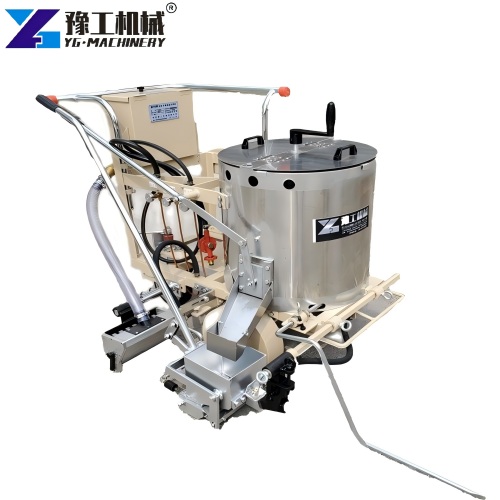

A road striping machine should be selected from the stripe specification and coating route, not from a headline capacity alone. Before asking for a quotation, write down every required line width, the allowed edge variation, the material, the surface, the daily marking pattern and the access constraints. Those details determine whether a thermoplastic shoe, a single cold-paint gun or a double-gun arrangement is a sensible starting point.
This purchase-intent guide helps a buyer create an initial shortlist. YG figures below are published screening data: they support comparison, but they do not replace a trial using the buyer’s coating and surface. A useful supplier discussion connects machine, operator method, coating preparation and acceptance test as one working system. Separate fixed requirements from items that can be proven during testing, and ask the quotation to identify every assumption.
If your project includes several line widths or marking types, send the specification first so YG can identify the relevant machine route.
Start with the stripe specification
List center lines, edge lines, arrows, crossings and parking layouts separately because a wide continuous stripe does not prove that the same setup will produce a clean narrow symbol. Record nominal width in millimetres or centimetres, required thickness, glass-bead requirement where applicable, surface condition, slope, turns and the traffic-control window. Add the allowed edge variation and the number of repeated passes expected in a shift. Edge quality, not just maximum width, belongs in the buying brief.
Also record transitions. A contractor may need one setup to move from a 100 mm guidance line to a 450 mm boundary, or may prefer a repeatable dedicated width for a high-volume route. The first case calls for adjustment range and changeover discipline; the second may reward a simpler setting. Include photos or drawings when arrows, crossings, offsets or tight curves matter. This turns a generic inquiry into a configuration question.
Choose the coating route before the hardware
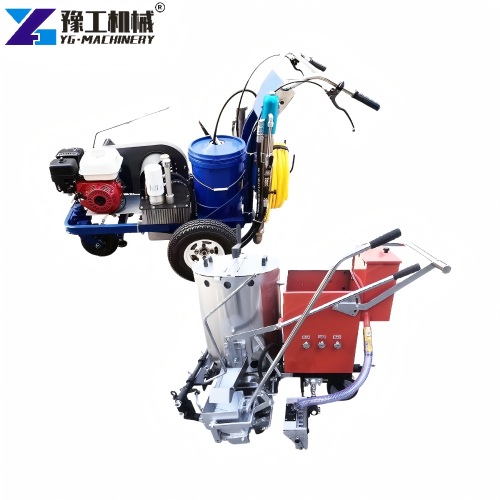
Thermoplastic and cold paint are different purchasing paths. The thermoplastic configuration supplied by YG uses a 120 kg paint bucket, 25 kg glass bead capacity, adjustable marking thickness of 1.8-3.0 mm and marking width of 100-450 mm. That combination is relevant when the project calls for heated material handling and controlled bead delivery, subject to final configuration confirmation. Do not compare its hopper capacity directly with a liquid-paint flow rate.
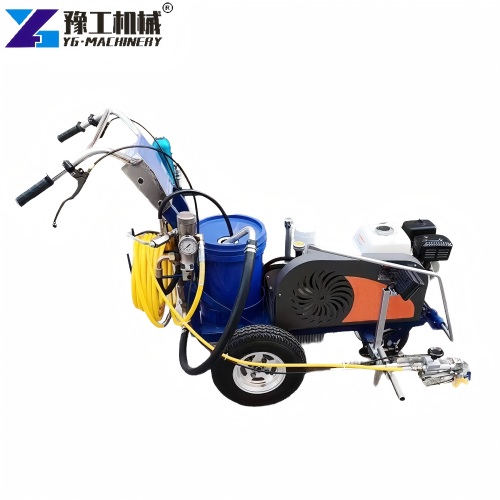
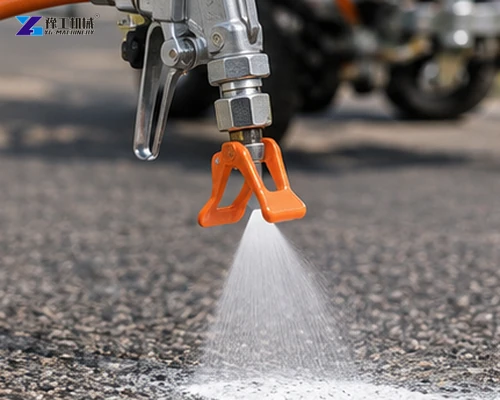
Cold paint is screened by liquid delivery. YG publishes a 6 L/min, 25 MPa, single-gun YG-6L and an 8 L/min, 30 MPa, double-gun YG-8L. The right choice depends on coating, width, number of simultaneous lines and how the operator keeps the machine aligned. Review the cold-paint road marking machine range when liquid coating is the actual requirement.
Once the material is known, share its application method and target stripe so the quotation compares compatible routes rather than unrelated machine types.
COMPARE COATING CONFIGURATIONS
Match gun, shoe and line-control method
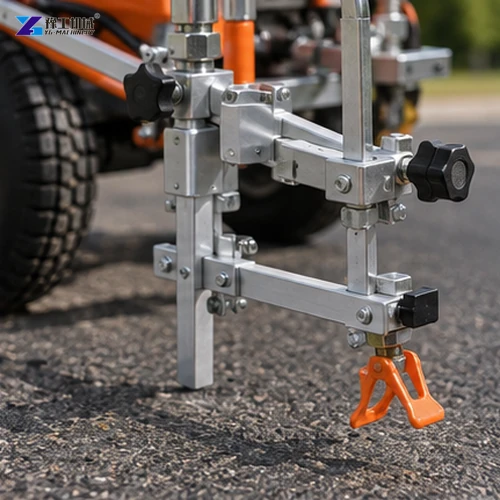
The delivery point is where the specification becomes visible on asphalt. A spray gun must be held at a consistent height and angle; a shoe or guide must stay stable over surface texture; and the machine must travel at a repeatable speed. Image3 shows adjustable front marking hardware, while image4 shows an operator maintaining a continuous line. Include adjustment points, sightline and handle access in the inspection discussion.
For cold paint, the single-gun YG-6L is published with a maximum spray width of 20 cm, while the double-gun YG-8L is published with a maximum spray width of 45 cm. A wider capability is not automatically better: frequent turns may favor one gun, while paired lines can reduce passes when spacing and coating permit it. Ask YG to confirm tip, hose and gun details for the selected material.

Verified YG screening parameters
Use this table to narrow the conversation, not to approve an untested production claim. The supplied values combine a thermoplastic configuration with two cold-paint model references; read each row within its coating route. Confirm final model, included components and project limits on the quotation.
| Configuration | Published feed or flow | Published width/thickness | Published mass and power |
| Thermoplastic | 120 kg paint bucket; 25 kg glass bead capacity | 100-450 mm marking width; 1.8-3.0 mm adjustable thickness | 110 kg; 1000x900x1100 mm |
| YG-6L cold paint, single gun | 6 L/min; 25 MPa | Maximum spray width 20 cm | 72 kg; 4.3 HP |
| YG-8L cold paint, double gun | 8 L/min; 30 MPa | Maximum spray width 45 cm | 128 kg; 7 HP |
The table suggests three checks. Compare required width with the published range or maximum. Check mass and dimensions against loading, storage and road access. Treat flow, pressure and power as configuration evidence that still needs to be matched to coating and method. Do not turn one attractive number into a guaranteed daily output. The broader road line marking machine product page is useful for general equipment context; this article narrows the selection to line width and acceptance.
Make a calibration strip part of the purchase
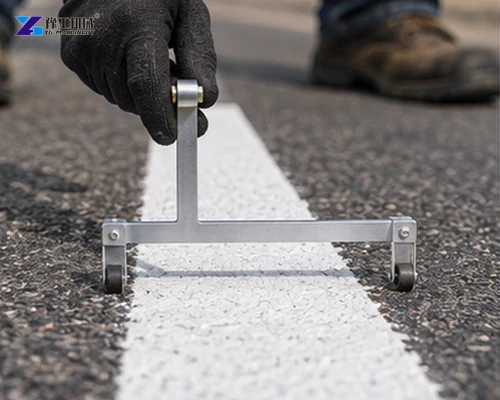
A calibration strip turns a specification into an observable decision. On a representative surface, mark a short sample at every required width. Measure the stripe at several points, inspect both edges, check thickness where required, record bead placement where applicable, and note travel method, pressure or setting, nozzle or shoe position and coating batch. Image5 illustrates the close edge check that should be agreed before production.
Include starts, stops, turns and overlap. If a double-gun arrangement is proposed, inspect spacing and whether both lines remain consistent. If thermoplastic is proposed, include the bead observation relevant to the brief. This lets the supplier distinguish machine limitation from material preparation or operator setting. Define a pass/fail record before the demonstration, not after a disappointing result.
If line acceptance depends on measured width or edge quality, include those observations in your inquiry so the proposed setup can be reviewed against them.
Balance width, passes and crew workload
Job scale is more than road length. Count line types, passes, repositioning time, refill or material handling, traffic-control windows and cleaning between materials. A machine that covers the required width may still be a poor fit if the crew cannot maintain alignment or if the route forces frequent changeovers. Ask how the proposed layout affects one operator, a spotter and any material-handling support.
Image6 shows the visual difference between single- and double-gun arrangements. Use it to discuss whether simultaneous marking is genuinely useful for the layout. Include operator sightline, handle position and access to controls. Estimate productivity only after line mix, travel pattern, refill cycle and trial method are clear; avoid importing an output claim from a different coating or road surface.

Inspect the fluid path and maintenance points
Line quality can deteriorate when the delivery path is dirty or a filter is neglected. Image7 shows a removed mesh filter beside the fluid connection, making this a useful inspection and training point. Ask where filters, hoses, guns, tips and seals are located, how they are cleaned, and which components are included. Keep maintenance questions tied to the selected coating rather than assuming one routine fits every material.
Before approval, check that the machine can be safely moved and stored, that the operator can see the marking point, and that the quotation identifies accessories or utilities excluded from the base configuration. These details prevent a suitable-looking machine from arriving without the parts needed for the first test. Put cleaning responsibility and spare-parts assumptions in writing.
Turn the brief into an acceptance-ready quote
Send YG the coating and preparation method, target widths and thickness, bead requirement, surface description, line pattern, site location, available power or fuel conditions, transport limits and crew plan. Attach a drawing or road photograph when alignment, arrows or crossings matter. State how the sample will be measured and what counts as a pass.
Ask the quotation to identify selected model, gun or shoe arrangement, published limits, included items, unresolved assumptions and recommended trial. A clear record keeps the purchase decision attached to the real road-marking task. If the project requires a wider comparison, use the product page as a next reading rather than mixing model values from different coating routes.
With the coating, line schedule, site conditions and acceptance method assembled, you can request a quote specific enough to review.

Finish with the marking outcome
The final shortlist should explain why each candidate fits the specified width, coating and work pattern, what must be proven on the calibration strip, and which limits remain open. Image8 shows the finished layout that the acceptance discussion is meant to protect: consistent geometry, clean edges and a repeatable route result. Include the required information with your inquiry so YG can respond to the actual configuration rather than the keyword alone.

Road Striping Machine FAQ
List each required stripe width and edge tolerance, compare it with the published range or maximum for the compatible coating route, and validate it on a calibration strip.
No. They use different material-handling routes and operating checks. Confirm that the proposed machine is intended for the coating specified for your project.
It can help when the layout and coating allow two lines to be marked together. Compare the YG-8L arrangement with actual spacing, turns and operator control.
YG publishes a maximum spray width of 20 cm for the single-gun YG-6L. Treat it as screening data and confirm tip, coating and test conditions.
Record width at several points, edge quality, thickness where required, bead placement where applicable, settings, travel method and the pass/fail rule.
Send coating and preparation, target widths, thickness, bead requirement, surface, line layout, site conditions, utilities, transport limits, crew plan and acceptance method.