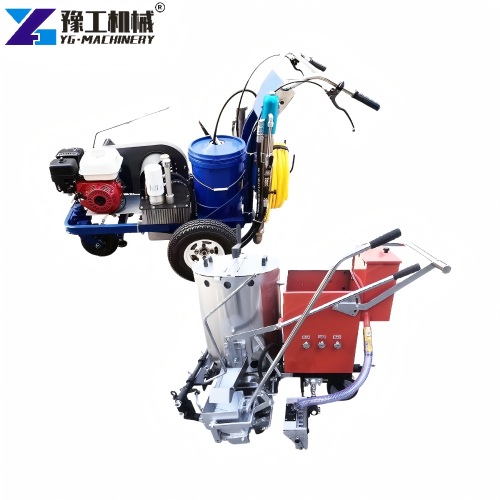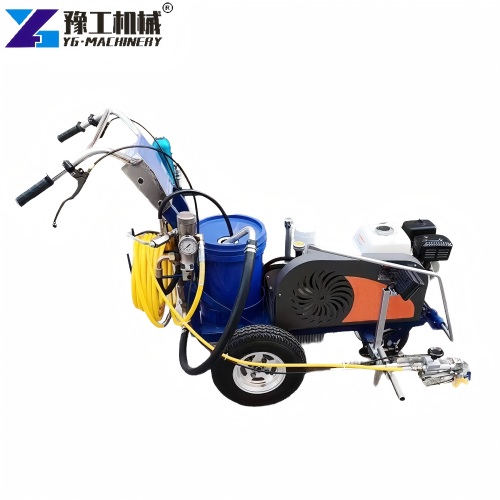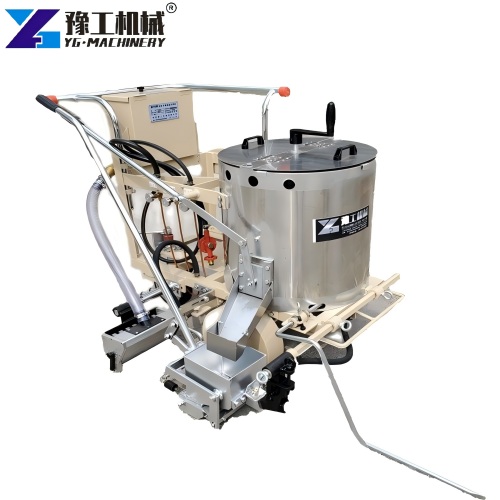
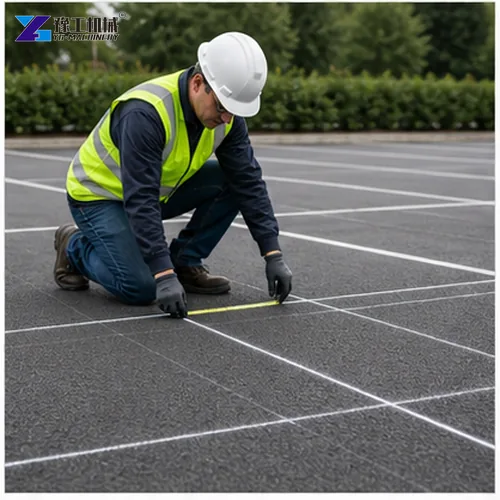
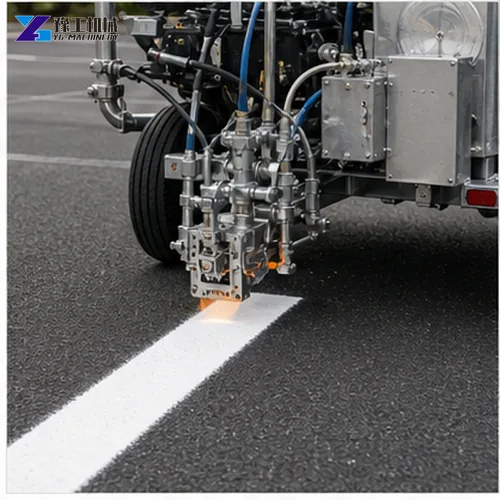
A Parking Lot Line Painting Machine turns a layout plan into durable bays, arrows, pedestrian routes and safety zones. The right machine depends on coating type, required line width, daily area, surface condition and local traffic-control rules. Buyers should compare delivered flow, pressure, tank capacity, bead application and operating method—not only purchase price.
YG offers thermoplastic and cold-paint configurations for different projects. Thermoplastic equipment heats and applies material that cools into a durable marking. A cold paint marking machine sprays a compatible liquid coating without a melting kettle. This guide uses the complete published model data and explains how to convert it into a practical purchasing decision.
Browse the YG road machinery range, compare related equipment in the Road Machine category, or contact YG Machinery with your parking layout and coating specification.
How a Parking Lot Line Painting Machine Applies Coating
A thermoplastic line marking machine controls heated material, screed width and bead distribution. A cold system uses hydraulic pressure and one or two guns to atomize paint. Stable travel speed and a correctly adjusted guide keep the line straight while the operator manages starts, stops and curves.
For how a parking lot line painting machine applies coating, treat every catalogue value as a model-selection input rather than a guarantee for every job. Actual output also depends on material, operator practice, site preparation, utilities and maintenance. Record the assumptions behind this decision so quotations can be compared on the same basis.
Start with a written product specification and an approved sample whenever output quality can be measured. Define who checks the first acceptable result, what instruments are used and how often production is sampled. A repeatable acceptance method gives operators a clear target and gives purchasing teams evidence when reviewing commissioning performance.
The selected marking system should be approved with the actual coating. Compare a parking lot striping machine test line, a thermoplastic line marking machine test line and a cold paint marking machine test line against the project specification.
Compare Parking Lot Striping Machine Models
Select thermoplastic when the specification calls for hot-applied markings and compatible glass beads. Select cold paint when the approved coating is applied at ambient temperature. The double-gun YG-CK8L offers 8 L/min and up to 45 cm width, while the single-gun version reaches 4.8 L/min and 30 cm.
Before finalizing compare parking lot striping machine models, ask the supplier to confirm the selected model, included equipment, electrical or hydraulic requirements, commissioning scope, wear parts and delivery configuration in writing. This review prevents a technically suitable machine from arriving without an item needed for normal production.
Compare models at the same operating condition. Headline capacity can be misleading when one quotation includes standard tooling and another assumes optional equipment. Ask vendors to identify every assumption, exclusion and consumable. A side-by-side worksheet should separate machine capability, included scope, utility demand, training and after-sales support.
Production planning for a parking lot striping machine must include layout time. A thermoplastic line marking machine also needs heating coordination, while a cold paint marking machine needs controlled pressure and cleanup.
The complete published parameters below are the comparison baseline for this Parking Lot Line Painting Machine. Confirm the final configuration against the source page and quotation.
| Parameter | YG-CK360S | YG-CK380S |
| System | Thermoplastic | Thermoplastic |
| Tank | 100 kg, double insulated stainless steel | 100 kg, double insulated stainless steel |
| Glass Bead Box | 10 kg | 10 kg |
| Bead Spreader | 50–200 mm, adjustable | 50–200 mm, adjustable |
| Standard / Optional Width | 150 mm / 100–450 mm | 150 mm / 100–450 mm |
| Battery | 48 V, 15 Ah lithium | 48 V, 15 Ah lithium |
| Drive Speed | 1–8 km/h | 1–8 km/h |
| Charge / Stated Work Period | 5 h / 24 h | 5 h / 24 h |
| Dimensions | 1210×970×1070 mm | 1200×970×1100 mm |
| Net Weight | 130 kg | 150 kg |
Cold Paint Marking Machine Parameters
| Parameter | YG-CK8L Single Gun | YG-CK8L Double Gun |
| Engine Power | 5.5 hp | 5.5 hp |
| Spray Guns | 1 | 2 |
| Spraying Flow | 4.8 L/min | 8 L/min |
| Pump | Electron reversal | Automatic reciprocating reverse |
| Drive | Hydraulic | Hydraulic |
| Working Pressure | 8–12 MPa | 8–12 MPa |
| Maximum Spray Width | 10–30 cm | 10–45 cm |
| Spray Thickness | 0.2–0.4 mm | 0.2–0.4 mm |
| Dimensions | 1600×800×1200 mm | 1600×800×1200 mm |
| Weight | 120 kg | 120 kg |
Plan Parking Lot Layout and Line Width
Confirm bay dimensions, accessible spaces, fire lanes, arrows, text, curb zones and pedestrian crossings before mobilization. Establish fixed reference points and mark control lines with a chalk line or approved pre-marking method. A parking lot striping machine follows the plan; it cannot correct missing dimensions or conflicting site instructions.
For plan parking lot layout and line width, treat every catalogue value as a model-selection input rather than a guarantee for every job. Actual output also depends on material, operator practice, site preparation, utilities and maintenance. Record the assumptions behind this decision so quotations can be compared on the same basis.
Material variability deserves its own control plan. Record supplier, batch, dimensions, coating or grade and storage condition before production begins. When results change, compare the material record with settings and inspection data. This approach is faster than adjusting several machine controls at once without knowing which change solved the problem.
Inspect the parking lot striping machine throughout the shift. Keep the thermoplastic line marking machine bead system consistent and keep each cold paint marking machine nozzle clean.

Prepare Pavement for Cold Paint Marking
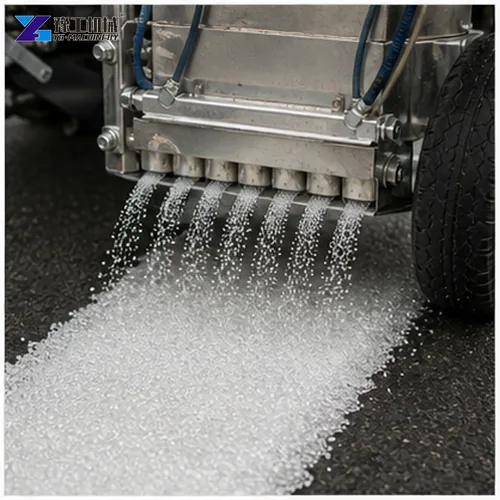
Remove dust, loose aggregate, oil, curing compounds and moisture that can weaken adhesion. Repair major cracks and failed areas before marking. Check the coating data for pavement compatibility, surface temperature, drying conditions and required primer. Mask sensitive edges when overspray would affect vehicles, walls or landscaping.
Before finalizing prepare pavement for cold paint marking, ask the supplier to confirm the selected model, included equipment, electrical or hydraulic requirements, commissioning scope, wear parts and delivery configuration in writing. This review prevents a technically suitable machine from arriving without an item needed for normal production.
Plan the work area around safe flow. Raw material should enter without crossing finished output, maintenance access or pedestrian routes. Provide lighting, housekeeping stations and clearly marked storage. Good layout reduces handling damage and gives operators enough room to inspect equipment without entering a pinch point or blocking an emergency exit.
Control Thermoplastic Line Marking Temperature
Heat thermoplastic material according to its supplier instructions and mix it evenly. Avoid overheating, contamination and long holding periods that can change application behavior. Verify hopper temperature and line thickness with approved tools. The thermoplastic line marking machine should move only when material flow and bead delivery are stable.
For control thermoplastic line marking temperature, treat every catalogue value as a model-selection input rather than a guarantee for every job. Actual output also depends on material, operator practice, site preparation, utilities and maintenance. Record the assumptions behind this decision so quotations can be compared on the same basis.
Commissioning should progress from inspection to no-load testing, low-speed trials and controlled production. Record baseline temperatures, pressures, dimensions or output readings that apply to the equipment. Train more than one responsible person and keep the manual near the work area. A signed handover list makes later troubleshooting more objective.
Set Up a Parking Lot Line Painting Machine
Inspect hoses, guards, wheels, guide rods, guns, hoppers, brakes and emergency controls. Fit the specified nozzle or marking bucket, then make a test stripe away from finished work. Measure width, thickness and bead coverage. Adjust pressure or travel pace gradually and document the accepted setting.
Before finalizing set up a parking lot line painting machine, ask the supplier to confirm the selected model, included equipment, electrical or hydraulic requirements, commissioning scope, wear parts and delivery configuration in writing. This review prevents a technically suitable machine from arriving without an item needed for normal production.
Use a simple pre-start checklist at every shift. Confirm guards, fasteners, fluid levels, cables, hoses, sensors, controls and emergency devices as applicable. Remove defective equipment from service and record the fault. Small abnormalities are easier and less expensive to correct before they become a quality failure or unplanned shutdown.
Maintain Consistent Parking Lot Striping Quality
Keep the guide aligned with the control mark and use smooth acceleration. Stop material flow cleanly at endpoints to avoid heavy deposits. Periodically verify width, straightness, coverage and drying. Wind, temperature and surface texture can change results during the shift, so quality checks should continue after the first acceptable line.
For maintain consistent parking lot striping quality, treat every catalogue value as a model-selection input rather than a guarantee for every job. Actual output also depends on material, operator practice, site preparation, utilities and maintenance. Record the assumptions behind this decision so quotations can be compared on the same basis.
Set a realistic production target from acceptable output, not maximum machine motion. Include material loading, changeovers, inspection, packaging and routine cleaning in the calculation. Measure good units or usable area per hour. This prevents scrap and rework from being counted as productivity and exposes the real constraint in the process.

Operate Cold Paint Marking Equipment Safely
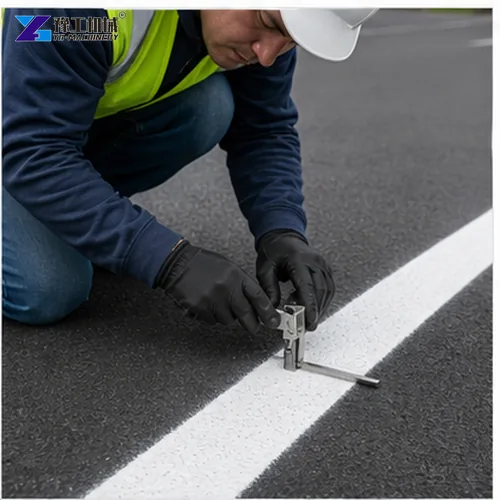
Follow coating safety data, provide ventilation and control ignition sources. Wear the specified eye, skin and respiratory protection. Relieve pressure before servicing a gun or hose; high-pressure injection injuries require immediate medical attention. Establish traffic barriers so vehicles and pedestrians cannot enter the wet work area.
Before finalizing operate cold paint marking equipment safely, ask the supplier to confirm the selected model, included equipment, electrical or hydraulic requirements, commissioning scope, wear parts and delivery configuration in writing. This review prevents a technically suitable machine from arriving without an item needed for normal production.
Operators need defined stop conditions. Examples include unstable material feed, abnormal noise, leakage, overheating, damaged guarding, loss of control response or people entering the exclusion area. Stopping early protects equipment and preserves evidence for diagnosis. Restart only after the responsible person confirms that the cause is controlled.
Clean and Maintain Line Marking Equipment
Use only the cleaning method and solvent approved for the coating and machine. Flush cold-paint circuits before material cures, clean nozzles without damaging the orifice and inspect filters. For thermoplastic equipment, remove residue safely while components are in the permitted cleaning condition and maintain mixers, burners and bead mechanisms.
For clean and maintain line marking equipment, treat every catalogue value as a model-selection input rather than a guarantee for every job. Actual output also depends on material, operator practice, site preparation, utilities and maintenance. Record the assumptions behind this decision so quotations can be compared on the same basis.
Build preventive maintenance around operating hours, calendar intervals and observed condition. Identify critical wear items, normal lead times and minimum spare quantities. Store components cleanly and use the specified lubricants and replacement procedures. Maintenance planning is especially important when international shipping could extend the recovery time after an avoidable failure.
Calculate Parking Lot Marking Ownership Cost
Compare labor, coating loss, setup time, cleaning time, spare nozzles, buckets, filters, batteries, fuel and transport. A higher-output unit creates value only when layout, material supply and crew capacity support it. Include training, service access and the cost of downtime during time-sensitive parking closures.
Before finalizing calculate parking lot marking ownership cost, ask the supplier to confirm the selected model, included equipment, electrical or hydraulic requirements, commissioning scope, wear parts and delivery configuration in writing. This review prevents a technically suitable machine from arriving without an item needed for normal production.
Estimate total cost over the intended service period. Include installation, utilities, labor, consumables, planned maintenance, tooling, freight, taxes where applicable and expected utilization. Compare the financial effect of output quality and downtime as well as energy use. The lowest initial quotation is not always the lowest cost per accepted unit.

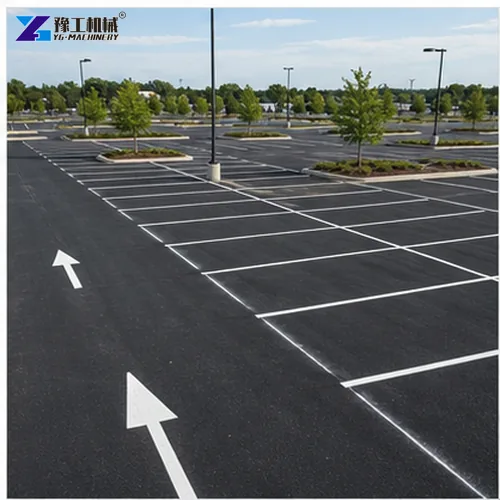
Parking Lot Line Painting Machine Buyer Checklist
Send the supplier the coating type, expected line widths, project area, daily target, single- or double-line needs, surface type, voltage, climate and destination. Request a written model comparison and complete packing list. Confirm whether bead equipment, guides, spare guns, nozzles and commissioning support are included.
For parking lot line painting machine buyer checklist, treat every catalogue value as a model-selection input rather than a guarantee for every job. Actual output also depends on material, operator practice, site preparation, utilities and maintenance. Record the assumptions behind this decision so quotations can be compared on the same basis.
Ask for practical training that covers setup, normal adjustments, cleaning, inspection, fault messages and emergency actions. Video guidance is useful, but the factory should also maintain its own records in the working language. Assign responsibility for settings and spare parts so changes are controlled rather than passed informally between shifts.
Parking Lot Line Painting Machine FAQ
No. The published configurations use different material-handling systems. Select equipment designed for the approved coating process.
The YG-CK8L single-gun model is listed at 10–30 cm, while the double-gun model is listed at 10–45 cm.
A test stripe verifies width, thickness, atomization or material flow, bead coverage and operator alignment before finished markings begin.
Provide coating type, widths, project size, required output, surface, power conditions, optional equipment and destination.
Request a Parking Lot Line Painting Machine Recommendation
Send YG Machinery your application, required output, site conditions and destination. The team can compare the complete model data and prepare a suitable Parking Lot Line Painting Machine configuration and quotation.