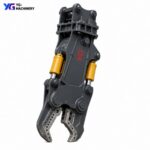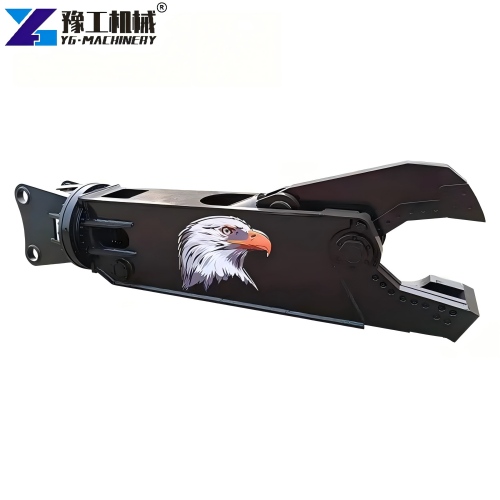

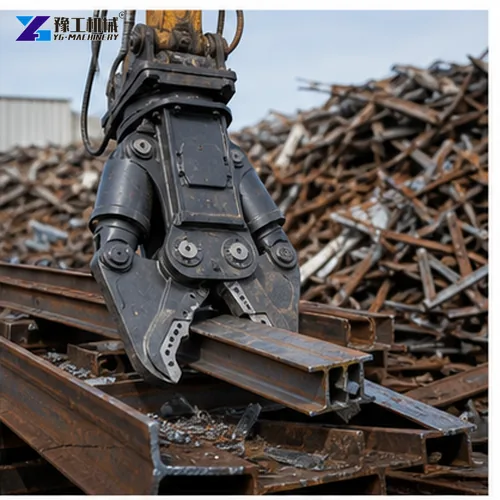
A Metal Shear Excavator attachment uses the carrier hydraulic system to cut structural steel, plate, rebar and scrap from a protected cab. Correct selection begins with excavator class, attachment weight, hydraulic pressure, opening, shear depth and force distribution. The largest quoted force alone does not prove that an attachment matches the carrier or target material.
YG publishes five hydraulic shear models for excavators from 5–9 t through 38–50 t. Their weights range from 620 to 4052 kg, and the published openings range from 334.4 to 801 mm. This guide presents every available parameter and explains carrier matching, work planning, cutting control, inspection and ownership.
Compare the broader hydraulic shear range, review another attachment such as the excavator drum cutter, or send YG your carrier data for matching.
How a Hydraulic Metal Shear Produces Cutting Force
The excavator supplies pressurized oil to the attachment cylinder. Jaw geometry converts cylinder force into different cutting forces at the tip, middle and bottom. Material should enter the suitable jaw zone; thick or difficult sections normally require the deeper, stronger area rather than repeated tip loading.
For how a hydraulic metal shear produces cutting force, treat every catalogue value as a model-selection input rather than a guarantee for every job. Actual output also depends on material, operator practice, site preparation, utilities and maintenance. Record the assumptions behind this decision so quotations can be compared on the same basis.
Start with a written product specification and an approved sample whenever output quality can be measured. Define who checks the first acceptable result, what instruments are used and how often production is sampled. A repeatable acceptance method gives operators a clear target and gives purchasing teams evidence when reviewing commissioning performance.
Match the Metal Shear Excavator with a hydraulic metal shear circuit, the intended excavator scrap shear task and the approved demolition shear attachment bracket.
Compare Metal Shear Excavator Models
Match the published carrier range first, then check attachment mass, maximum opening, shear depth, pressure and dimensions. YG-620 serves listed 5–9 t carriers, while YG-4052 is listed for 38–50 t machines. Intermediate models cover distinct carrier classes and should not be selected only by opening.
Before finalizing compare metal shear excavator models, ask the supplier to confirm the selected model, included equipment, electrical or hydraulic requirements, commissioning scope, wear parts and delivery configuration in writing. This review prevents a technically suitable machine from arriving without an item needed for normal production.
Compare models at the same operating condition. Headline capacity can be misleading when one quotation includes standard tooling and another assumes optional equipment. Ask vendors to identify every assumption, exclusion and consumable. A side-by-side worksheet should separate machine capability, included scope, utility demand, training and after-sales support.
Test the Metal Shear Excavator at low speed. Confirm hydraulic metal shear control, excavator scrap shear rotation and demolition shear attachment stability.
The complete published parameters below are the comparison baseline for this Metal Shear Excavator. Confirm the final configuration against the source page and quotation.
| Parameter | YG-620 | YG-1413 | YG-2200 | YG-2977 | YG-4052 |
| Weight | 620 kg | 1413 kg | 2200 kg | 2977 kg | 4052 kg |
| Maximum Opening | 334.4 mm | 540 mm | 500 mm | 660 mm | 801 mm |
| Width | 864 mm | 1175 mm | 1370 mm | 1600 mm | 1700 mm |
| Height | 1521 mm | 2050 mm | 2380 mm | 2600 mm | 2700 mm |
| Effective Shear Depth | 286 mm | 348 mm | 486 mm | 578 mm | 736 mm |
| Rotation | 360 collision | 360 hydraulic | 360 hydraulic | 360 hydraulic | 360 hydraulic |
| Working Pressure | 235 bar | 300 bar | 320 bar | 320 bar | 320 bar |
| Bottom Force | 81.2 t | 138.2 t | 171.2 t | 330.2 t | 387.2 t |
| Middle Force | 50.2 t | 80.2 t | 100.2 t | 189.2 t | 218.2 t |
| Tip Force | 32.2 t | 53.2 t | 75.2 t | 127.2 t | 147.2 t |
| Excavator Class | 5–9 t | 10–19 t | 20–25 t | 28–35 t | 38–50 t |
Match a Demolition Shear Attachment to the Carrier
Obtain written approval for attachment weight, center of gravity, boom configuration, lift capacity and stability across the working envelope. Confirm auxiliary flow, pressure, return line, case drain if required and rotation circuit. The excavator must remain stable while positioning and cutting, including when material moves unexpectedly.
For match a demolition shear attachment to the carrier, treat every catalogue value as a model-selection input rather than a guarantee for every job. Actual output also depends on material, operator practice, site preparation, utilities and maintenance. Record the assumptions behind this decision so quotations can be compared on the same basis.
Material variability deserves its own control plan. Record supplier, batch, dimensions, coating or grade and storage condition before production begins. When results change, compare the material record with settings and inspection data. This approach is faster than adjusting several machine controls at once without knowing which change solved the problem.
Document hydraulic metal shear settings, excavator scrap shear blade condition and demolition shear attachment maintenance.

Use Opening and Shear Depth Correctly
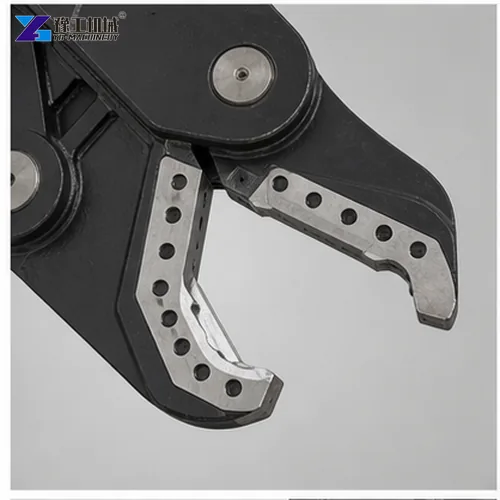
Maximum opening describes the jaw gap, not a universal cutting capacity. Section shape, grade, thickness, orientation and remaining support change the demand. Effective shear depth indicates how far material can enter the jaw. Provide drawings or representative scrap dimensions so the supplier can review real cutting tasks.
Before finalizing use opening and shear depth correctly, ask the supplier to confirm the selected model, included equipment, electrical or hydraulic requirements, commissioning scope, wear parts and delivery configuration in writing. This review prevents a technically suitable machine from arriving without an item needed for normal production.
Plan the work area around safe flow. Raw material should enter without crossing finished output, maintenance access or pedestrian routes. Provide lighting, housekeeping stations and clearly marked storage. Good layout reduces handling damage and gives operators enough room to inspect equipment without entering a pinch point or blocking an emergency exit.
Understand Excavator Scrap Shear Force Zones
Published force is highest at the bottom and lower at the tip for every listed model. The YG-2977, for example, lists 330.2 t bottom force, 189.2 t middle force and 127.2 t tip force. Positioning material deeper can improve leverage, but the operating manual controls permitted technique.
For understand excavator scrap shear force zones, treat every catalogue value as a model-selection input rather than a guarantee for every job. Actual output also depends on material, operator practice, site preparation, utilities and maintenance. Record the assumptions behind this decision so quotations can be compared on the same basis.
Commissioning should progress from inspection to no-load testing, low-speed trials and controlled production. Record baseline temperatures, pressures, dimensions or output readings that apply to the equipment. Train more than one responsible person and keep the manual near the work area. A signed handover list makes later troubleshooting more objective.
Plan Structural Demolition Cutting Sequence
Survey the structure, identify utilities, hazardous materials, stored energy and load paths, and establish an engineered sequence. Support components before severing them and control the drop zone. A demolition shear attachment should reduce material predictably; it must not be used to pull an uncertain structure toward workers or occupied areas.
Before finalizing plan structural demolition cutting sequence, ask the supplier to confirm the selected model, included equipment, electrical or hydraulic requirements, commissioning scope, wear parts and delivery configuration in writing. This review prevents a technically suitable machine from arriving without an item needed for normal production.
Use a simple pre-start checklist at every shift. Confirm guards, fasteners, fluid levels, cables, hoses, sensors, controls and emergency devices as applicable. Remove defective equipment from service and record the fault. Small abnormalities are easier and less expensive to correct before they become a quality failure or unplanned shutdown.
Process Scrap Metal Efficiently
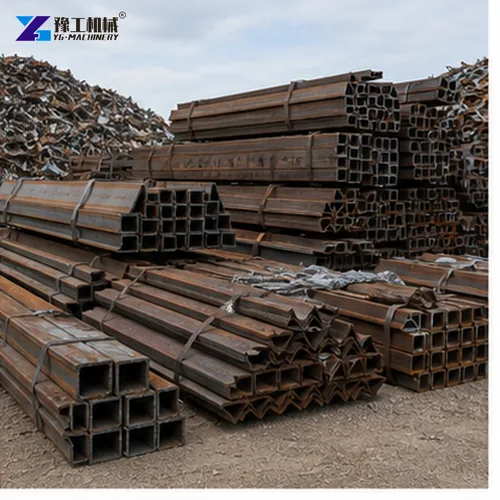
Sort material by size and section where practical. Present pieces squarely to the jaws and use rotation to improve alignment without excessive carrier travel. Avoid cutting against the ground, which can damage blades and contaminate material. Coordinate trucks and stockpiles so processed scrap does not block the excavator escape route.
For process scrap metal efficiently, treat every catalogue value as a model-selection input rather than a guarantee for every job. Actual output also depends on material, operator practice, site preparation, utilities and maintenance. Record the assumptions behind this decision so quotations can be compared on the same basis.
Set a realistic production target from acceptable output, not maximum machine motion. Include material loading, changeovers, inspection, packaging and routine cleaning in the calculation. Measure good units or usable area per hour. This prevents scrap and rework from being counted as productivity and exposes the real constraint in the process.

Operate a Hydraulic Metal Shear Safely
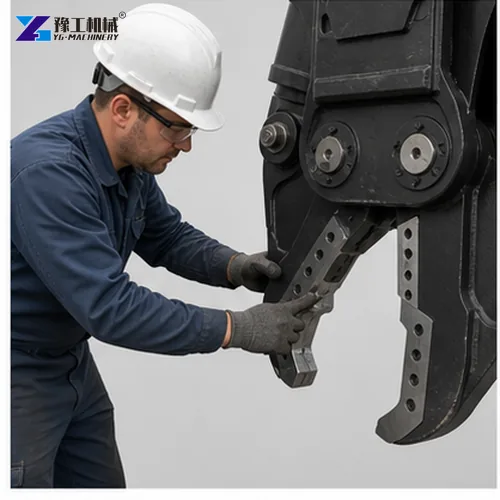
Create an exclusion zone for falling, swinging and ejected material. Inspect the carrier quick coupler and hydraulic connections before work. Never allow anyone beneath the attachment or within the cutting radius. Stop if visibility, communication, carrier stability, hydraulic temperature or structural behavior moves outside the approved plan.
Before finalizing operate a hydraulic metal shear safely, ask the supplier to confirm the selected model, included equipment, electrical or hydraulic requirements, commissioning scope, wear parts and delivery configuration in writing. This review prevents a technically suitable machine from arriving without an item needed for normal production.
Operators need defined stop conditions. Examples include unstable material feed, abnormal noise, leakage, overheating, damaged guarding, loss of control response or people entering the exclusion area. Stopping early protects equipment and preserves evidence for diagnosis. Restart only after the responsible person confirms that the cause is controlled.
Inspect Blades and Hydraulic Components
Check blades, bolts, jaw pins, cylinder, rotation system, hoses, fittings and attachment structure each shift. Look for cracks, looseness, leakage, abnormal heat and uneven blade contact. Relieve stored pressure before maintenance and support the attachment securely. Welding or structural repair requires the approved procedure.
For inspect blades and hydraulic components, treat every catalogue value as a model-selection input rather than a guarantee for every job. Actual output also depends on material, operator practice, site preparation, utilities and maintenance. Record the assumptions behind this decision so quotations can be compared on the same basis.
Build preventive maintenance around operating hours, calendar intervals and observed condition. Identify critical wear items, normal lead times and minimum spare quantities. Store components cleanly and use the specified lubricants and replacement procedures. Maintenance planning is especially important when international shipping could extend the recovery time after an avoidable failure.
Maintain an Excavator Scrap Shear
Rotate or replace reversible blades at the specified wear limit, maintain clearances and use the stated bolt torque. Lubricate pins at the required interval and keep hydraulic oil clean. Small leaks can become injection hazards or introduce contamination; repair them promptly instead of compensating with additional oil.
Before finalizing maintain an excavator scrap shear, ask the supplier to confirm the selected model, included equipment, electrical or hydraulic requirements, commissioning scope, wear parts and delivery configuration in writing. This review prevents a technically suitable machine from arriving without an item needed for normal production.
Estimate total cost over the intended service period. Include installation, utilities, labor, consumables, planned maintenance, tooling, freight, taxes where applicable and expected utilization. Compare the financial effect of output quality and downtime as well as energy use. The lowest initial quotation is not always the lowest cost per accepted unit.

Calculate Hydraulic Shear Ownership Cost
Include attachment price, coupler or bracket, hydraulic plumbing, installation, freight, blade sets, bolts, lubrication, inspection and downtime. Productivity depends on material preparation and carrier utilization. A larger shear can raise transport and fuel demands if the job rarely uses its capacity.
For calculate hydraulic shear ownership cost, treat every catalogue value as a model-selection input rather than a guarantee for every job. Actual output also depends on material, operator practice, site preparation, utilities and maintenance. Record the assumptions behind this decision so quotations can be compared on the same basis.
Ask for practical training that covers setup, normal adjustments, cleaning, inspection, fault messages and emergency actions. Video guidance is useful, but the factory should also maintain its own records in the working language. Assign responsibility for settings and spare parts so changes are controlled rather than passed informally between shifts.
Metal Shear Excavator Buyer Checklist
Provide carrier make and model, operating weight, boom, auxiliary flow and pressure, coupler, intended material, maximum section, working height, rotation needs and destination. Request the exact attachment drawing, weight, pressure requirement, included bracket, hoses, blade spares and commissioning guidance before confirming the order.
Before finalizing metal shear excavator buyer checklist, ask the supplier to confirm the selected model, included equipment, electrical or hydraulic requirements, commissioning scope, wear parts and delivery configuration in writing. This review prevents a technically suitable machine from arriving without an item needed for normal production.
Before shipment, confirm dimensions, weight, lifting points, packing method, container plan and required unloading equipment. Review foundation and utility work early enough to avoid storage delays after arrival. Keep photos and packing lists with the purchase record. Careful logistics protect both the equipment and the planned commissioning date.
Metal Shear Excavator FAQ
No. Carrier class is the first filter, but hydraulic capacity, stability, boom geometry, coupler and application must also be confirmed.
The complete table shows the highest force at the bottom jaw zone for all five listed models.
No. Opening is jaw clearance; actual suitability also depends on material grade, section, thickness, orientation and cutting position.
Send complete carrier details, hydraulic data, target material and dimensions, coupler information, working conditions and destination.
Request a Metal Shear Excavator Recommendation
Send YG Machinery your application, required output, site conditions and destination. The team can compare the complete model data and prepare a suitable Metal Shear Excavator configuration and quotation.