If you are planning an egg tray factory, asking only for the forming machine price will not tell you the real investment. The egg tray manufacturing plant cost also includes pulping, drying, molds, utilities, labor, factory preparation, installation, raw materials, and working capital. A cheap machine quotation can therefore become an expensive project when these additional requirements are added later.
The better approach is to build the factory around your expected market demand. A 1,000 pcs/h startup line and a 7,000 pcs/h industrial line require very different levels of electricity, raw paper, drying capacity, storage, and production management. Understanding these differences before ordering equipment helps you control both the initial investment and long-term operating cost.
Egg Tray Manufacturing Plant Equipment Parameters
| Model | Capacity | Forming Moulds | Total Power | Electricity Consumption | Workers |
| YG-1×3 | 1,000 pcs/h | 3 | 40 kW | 28 kW/h | 3–5 |
| YG-1×4 | 1,500 pcs/h | 4 | 40 kW | 29 kW/h | 4–6 |
| YG-3×4 | 2,500 pcs/h | 12 | 50 kW | 35 kW/h | 4–6 |
| YG-4×4 | 3,500 pcs/h | 16 | 60 kW | 42 kW/h | 4–6 |
| YG-4×8 | 4,500 pcs/h | 32 | 130 kW | 91 kW/h | 4–6 |
| YG-5×8 | 5,500 pcs/h | 40 | 140 kW | 98 kW/h | 5–7 |
| YG-6×8 | 7,000 pcs/h | 48 | 186 kW | 130 kW/h | 6–8 |
The table shows why capacity cannot be considered alone. As output increases, forming molds, total power, electricity requirements, drying capacity, and material handling requirements also increase. A larger line can reduce unit production cost when demand is stable, but oversized equipment can increase capital pressure when production capacity remains unused.
Before selecting a model, buyers should estimate realistic monthly sales rather than designing the factory around theoretical maximum output. This simple step can prevent unnecessary investment.
Where Does Egg Tray Manufacturing Plant Cost Actually Go?
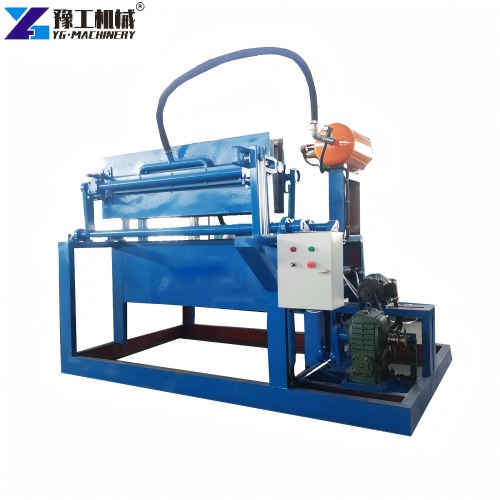
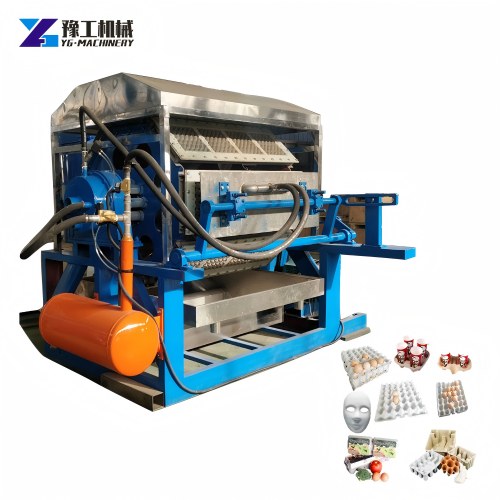
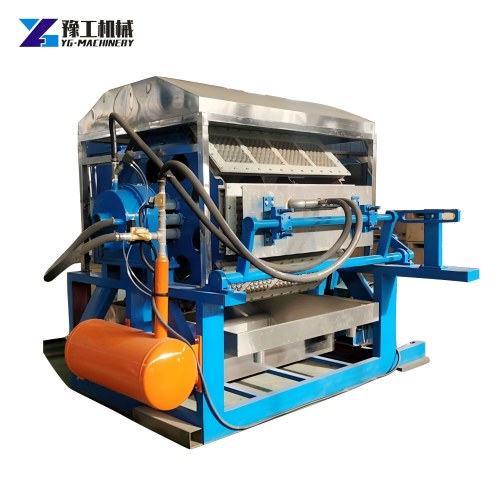
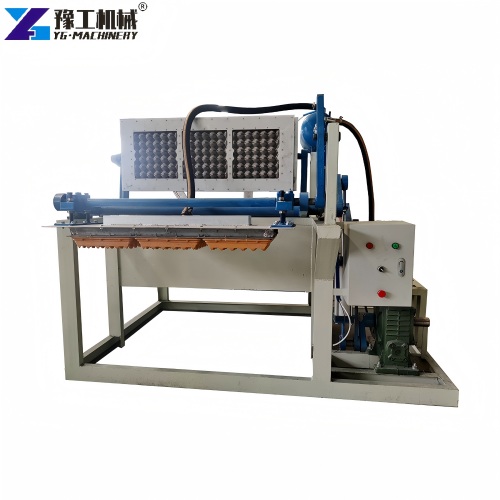
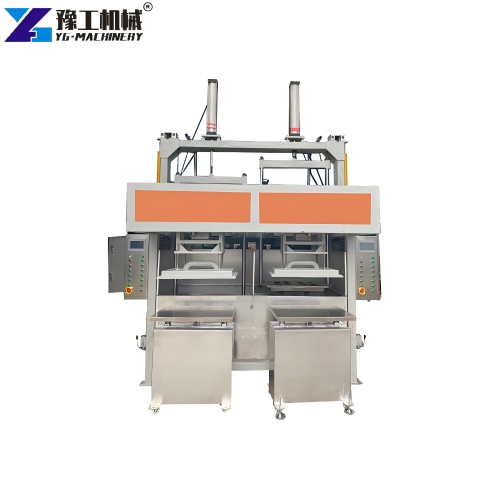
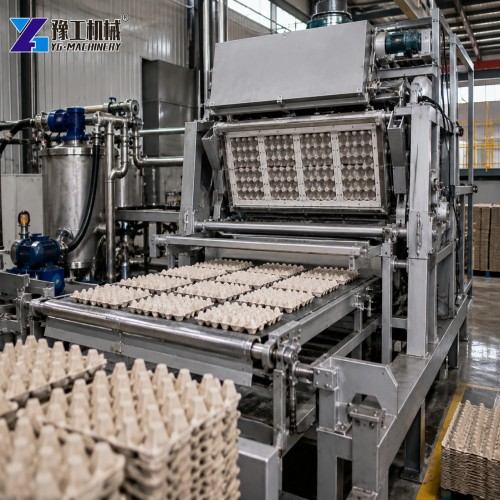
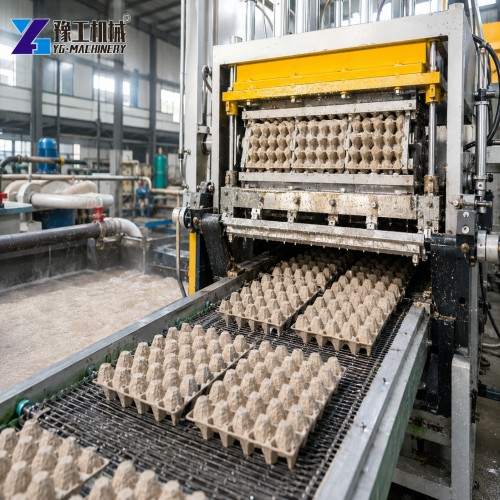
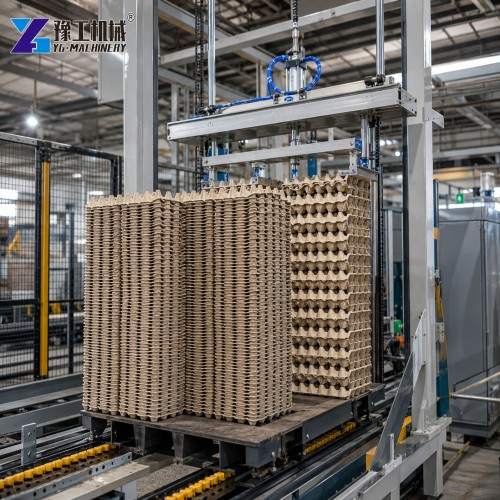
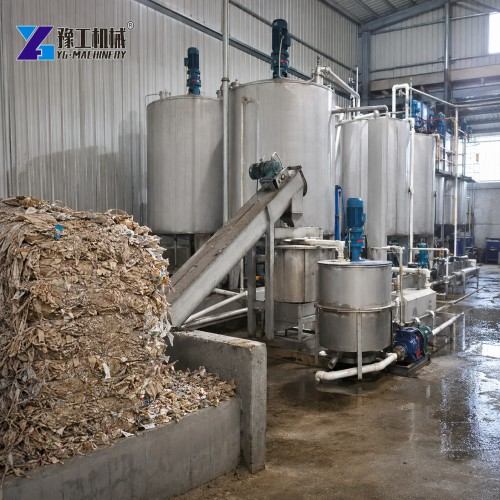
The forming machine is only one part of a complete factory. A working paper egg tray production line normally needs pulping equipment, forming equipment, vacuum and water circulation systems, molds, drying, product collection, and electrical control. Higher automation levels may also introduce stacking, conveying, and other material-handling equipment.
Factory preparation creates another group of costs. Electricity supply, water tanks, drainage, foundations, fuel systems, raw-paper storage, finished-product storage, and safe working space may need to be prepared before installation. These items can represent a meaningful part of the project budget even though they are not included in the machine price.
A complete investment plan should normally consider:
- Pulping system
- Egg tray forming machine
- Vacuum and water circulation equipment
- Product molds
- Drying system
- Stacking or collecting equipment
- Factory electrical preparation
- Water supply and drainage
- Installation and commissioning
- Freight and import costs
- Initial raw material stock
- Working capital
Looking at the project this way gives a much more realistic egg tray manufacturing plant cost than comparing a single equipment quotation.
Drying Can Change Both Investment and Operating Cost
Drying is one of the biggest decisions in egg tray production because every tray leaves the forming machine with significant moisture. If the drying system cannot keep up with forming capacity, increasing machine output will not increase finished-product output. The dryer therefore needs to be selected together with the forming machine.
Natural drying can reduce initial equipment investment in suitable climates, but it requires more space and depends heavily on weather conditions. Rain, humidity, low temperatures, and seasonal changes can reduce production stability. It may still make sense for smaller projects where land is available and production requirements are moderate.
Higher-output plants normally require a more controlled drying solution. Options can include brick drying lines, single-layer metal dryers, and multilayer metal drying systems. The correct choice depends on capacity, local fuel availability, energy cost, factory space, and required automation.
A buyer comparing egg tray production line cost should therefore ask for the forming section and drying section to be quoted separately. This makes it easier to understand where the investment is going and whether the dryer matches the planned output.
How Much Capacity Can Your Market Actually Support?
A bigger production line does not automatically create a better business. A 7,000 pcs/h line can produce far more trays than a small startup line, but it also needs enough customers, waste paper, electricity, drying capacity, and warehouse space to keep that equipment productive. Unused capacity still requires capital without generating corresponding sales.
Start by identifying the buyers you can realistically serve. Egg farms, egg distributors, supermarkets, poultry companies, packaging wholesalers, and other local users can help you estimate monthly demand. Then compare this demand with the number of production hours you expect to operate.
For example, do not calculate production by assuming maximum rated capacity for every hour of every day. Allow for setup, maintenance, raw-material handling, product changeovers, downtime, and normal fluctuations in customer orders. A conservative production plan gives a more realistic basis for calculating egg tray plant cost and potential returns.
Raw Material Supply Can Decide Whether the Plant Remains Competitive
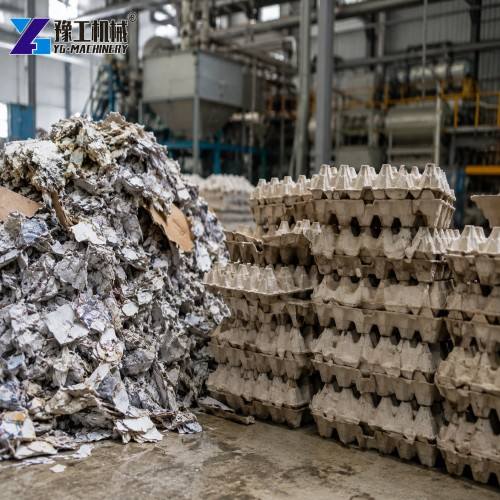
Waste paper is a major advantage of molded-pulp production, but waste paper is not automatically free. Old newspapers, cartons, printing waste, and other suitable paper materials still need collection, transport, sorting, storage, and processing. Local recycling prices can also change over time.
A factory located close to a reliable paper-waste supply may have a lower material cost than a plant that regularly transports raw material over long distances. Raw material quality matters as well because heavy contamination or inconsistent material can increase processing work.
Before investing, check:
- Local waste-paper price
- Available monthly volume
- Main suppliers
- Transport distance
- Storage space
- Material quality
- Seasonal price changes
This research should be completed before choosing production capacity. A high-output line cannot operate efficiently if the factory struggles to secure enough raw material.

Labor, Power and Factory Space Affect Every Month of Operation
Machine cost is paid mainly at the beginning, while labor and energy continue throughout the life of the plant. YG configurations range from approximately 3–5 workers for the 1,000 pcs/h model to around 6–8 workers for the 7,000 pcs/h configuration. Electricity requirements also increase substantially as capacity becomes larger.
Actual staffing depends on the complete factory design. Manual drying, raw-material movement, packing, warehouse handling, and product stacking can require additional labor beyond the forming section. Higher automation can reduce some manual work but increases the initial investment.
Factory layout should also be planned before equipment arrives. For one fully automatic arrangement, a reference factory space of approximately 50 × 18 meters with a height above 5 meters can be considered, but the final layout should always follow the selected capacity and existing building conditions. Poor layout increases handling distance and makes daily production less efficient.
How Should You Estimate the Return on Investment?
A realistic ROI calculation starts with saleable output rather than the rated machine capacity. Estimate how many trays can actually be produced and sold each month, then calculate local selling prices and expected revenue. After that, subtract the recurring costs required to keep production running.
A simple operating model can include:
- Sales revenue
- Waste paper
- Electricity and fuel
- Labor
- Packaging
- Maintenance
- Local transport
- Operating contribution
This number can then be compared with the total initial investment. However, it is safer to build several scenarios rather than assuming the factory will operate at maximum capacity from the first month.
Prepare a conservative case, a normal production case, and a high-utilization case. If the project is profitable only when every machine operates at maximum output, the investment may carry more risk than expected. This approach gives a more responsible view of egg tray manufacturing plant cost and potential ROI.
Small Plant or Higher-Automation Production Line?
A smaller plant can be a practical starting point when demand is still developing. Buyers can keep initial investment lower and use more manual handling where local labor costs allow it. The factory can then expand as customer demand becomes more predictable.
Higher-output plants benefit more from automation because manual handling becomes difficult when thousands of wet and finished trays move through the factory every hour. Automated forming, drying, stacking, and conveying can improve production consistency when volume is sufficient to justify the additional investment.
The correct choice therefore depends on local economics rather than the idea that more automation is always better. You can compare existing Egg Tray Manufacturing Machine configurations when planning the forming section of your factory.
What Should You Confirm Before Accepting a Plant Quotation?
Two suppliers can quote very different prices simply because their equipment scope is different. One quotation may include only the forming machine, while another contains pulping, drying, molds, accessories, spare parts, and installation support. Comparing the final numbers without checking the included systems can lead to the wrong decision.
Before placing an order, confirm:
- Production capacity
- Pulping configuration
- Forming machine model
- Number of molds
- Drying method
- Dryer capacity
- Power requirements
- Water requirements
- Labor requirements
- Fuel requirements
- Factory layout
- Spare parts
- Installation support
- Operator training
- Packing method
- Shipping terms
Also ask the supplier to identify what is not included. Hidden infrastructure and supporting-equipment costs are easier to control when they are discovered before production planning begins.

Why Choose YG Machinery?
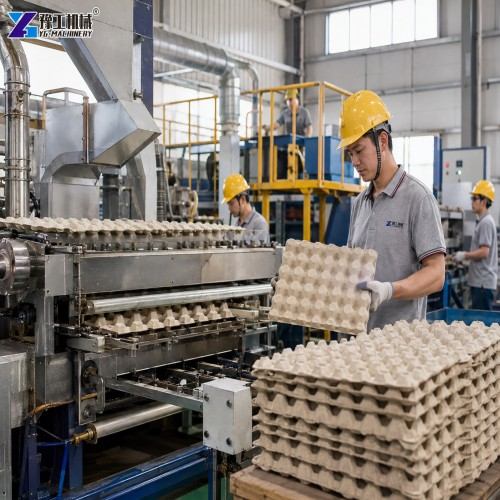
YG Machinery provides egg tray equipment ranging from smaller 1,000 pcs/h configurations to production lines reaching 7,000 pcs/h. Forming machines can be matched with different drying methods and factory layouts according to capacity, local energy conditions, available space, and automation requirements.
If you are calculating egg tray manufacturing plant cost, send us your expected capacity, working hours, factory dimensions, voltage, fuel options, raw-material conditions, and destination country. YG can help prepare a production-line configuration and quotation based on the actual requirements of your project.